I help enterprises move, trust, and leverage their data.

I'm a lead solutions engineer on IBM's North America Top team, working across IBM's agentic data engineering portfolio: real-time and batch data integration, data quality, and data governance for structured and unstructured data. I build repeatable assets that AEs and SEs actually use to scale our business: sales and technical playbooks, competitive benchmarks, and automated demo assets.

Field Enablement

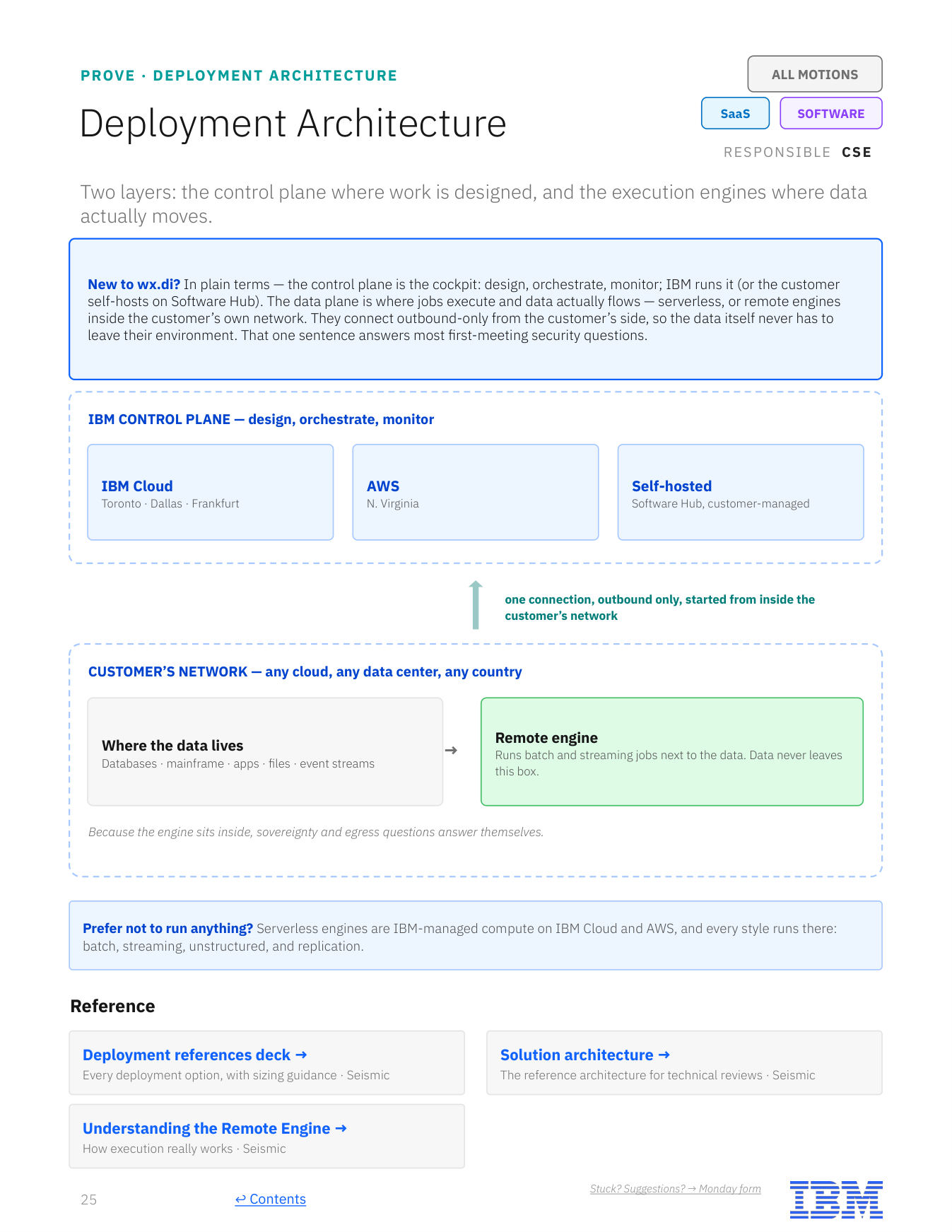
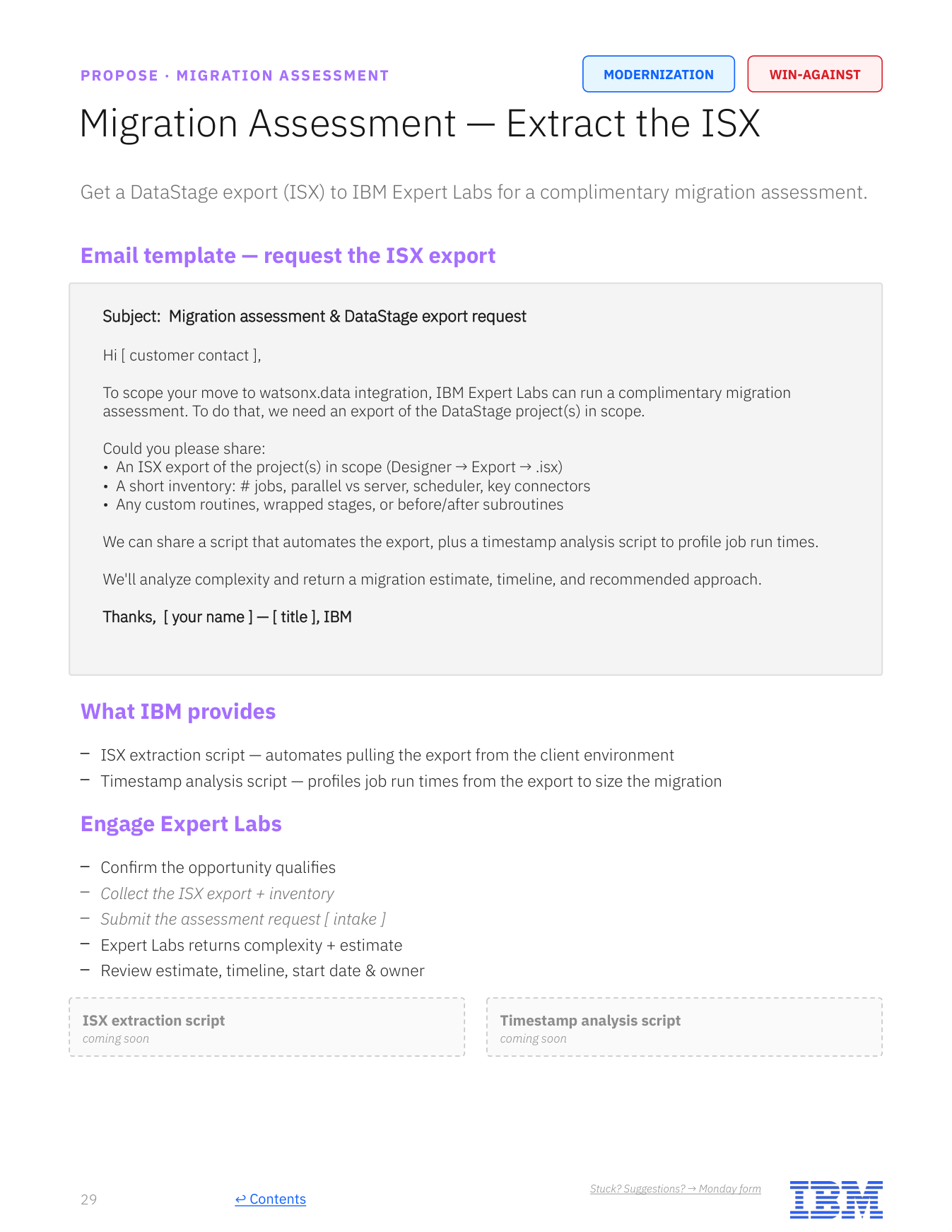
Data Integration Sales Playbook

The pain

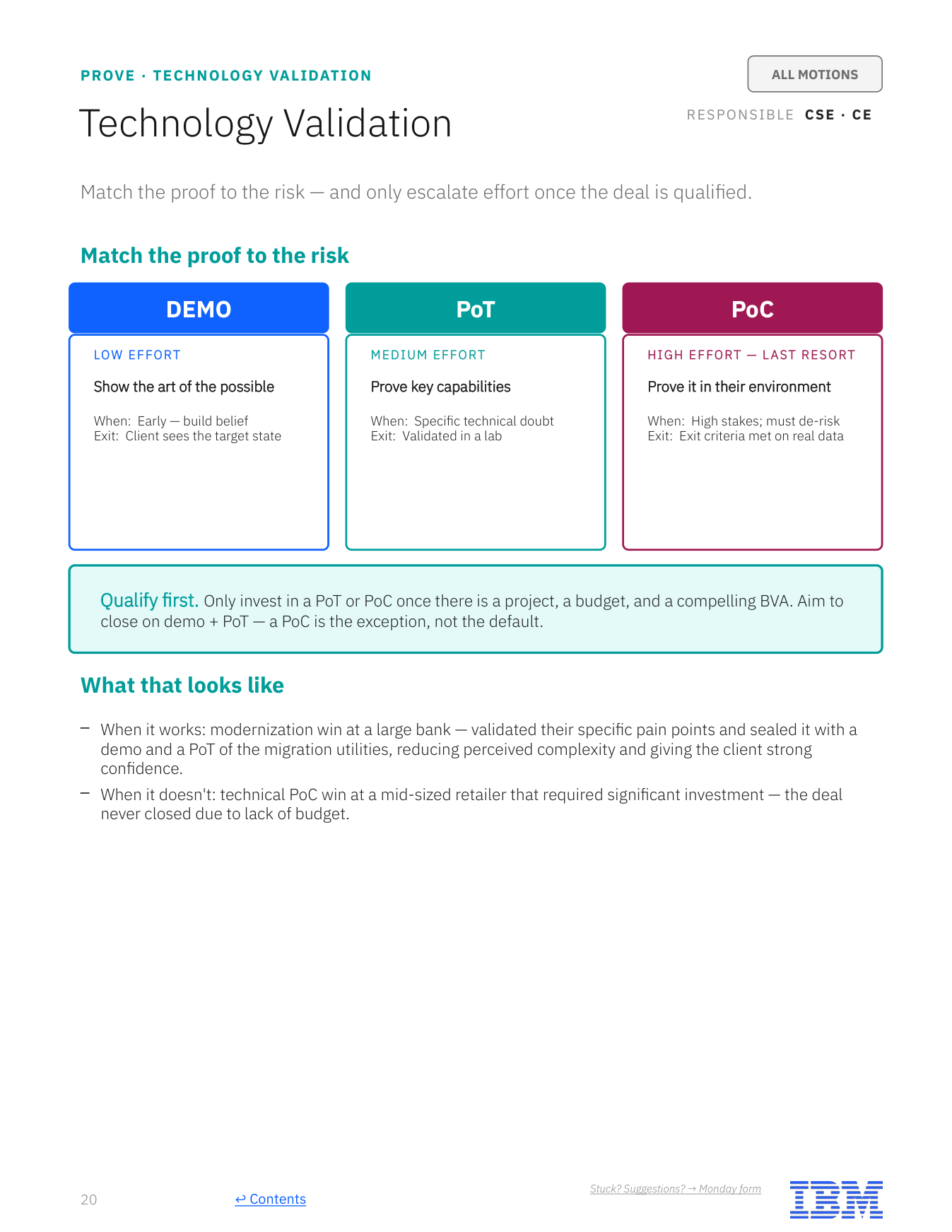
Seller productivity was bottlenecked by disparate, siloed access to decks, documentation, and links spread across many tools on our intranet. New hires took months to find their footing, nobody could tell them what to do next on the deal in front of them, and we kept spending proof-of-concept effort on deals nobody had qualified.

The outcome

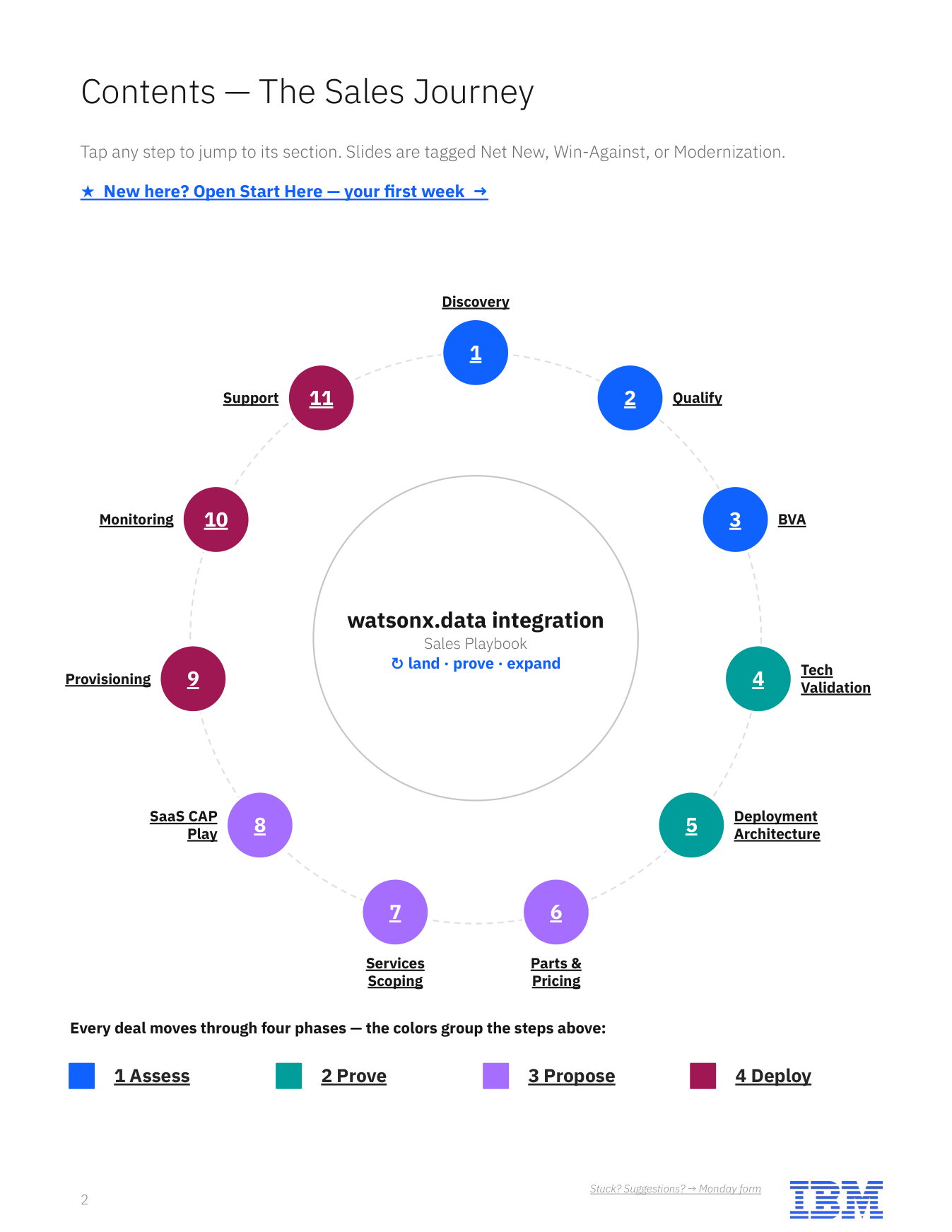
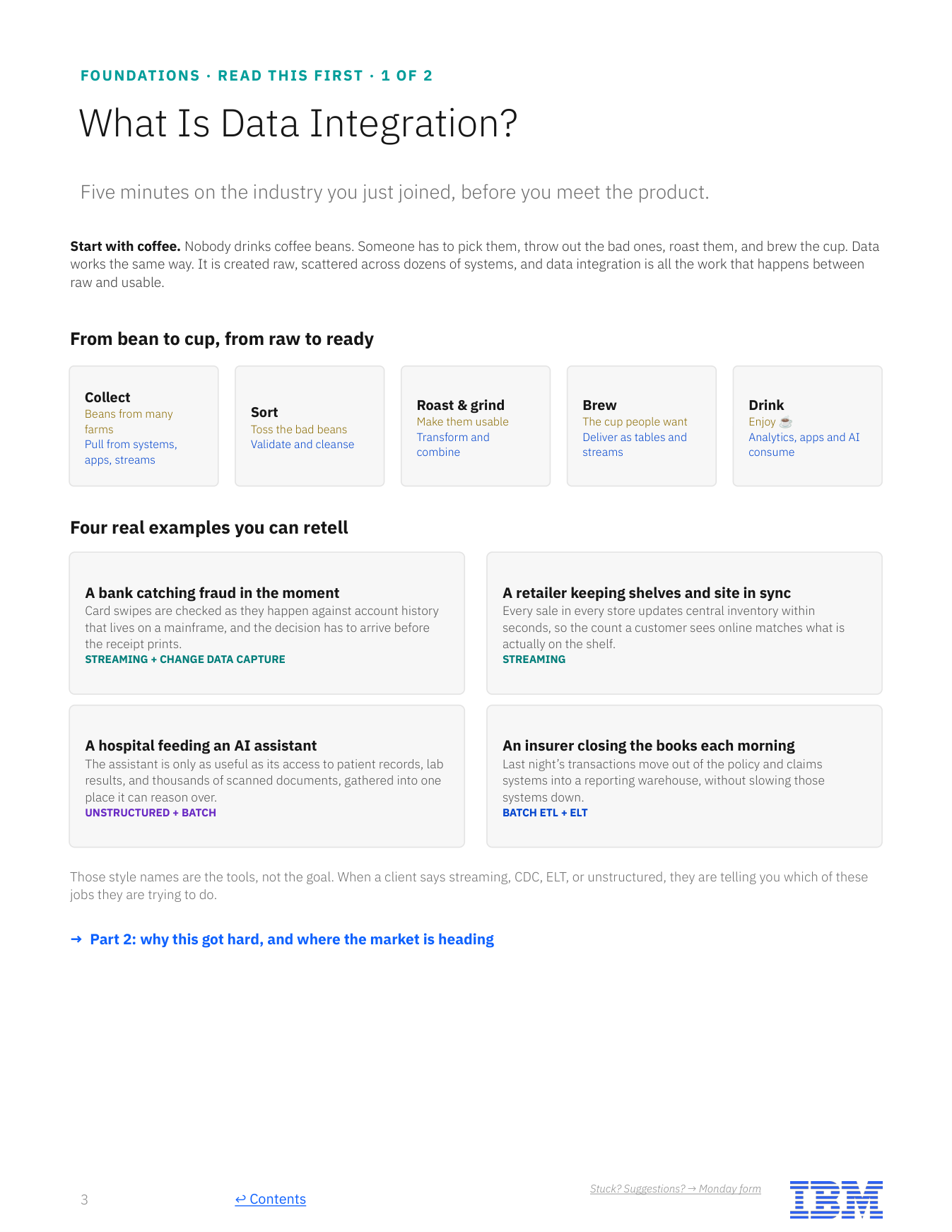
I wrote the playbook that walks a deal from first call to go-live. Eleven steps, and every page says which sales motion it applies to (Net New, Win-Against, Modernization) and who owns it. A new hire's first week now fits in about a day of work, any seller can find their next step in seconds, and there's a hard qualification gate before anyone commits proof work.

  • 4-phase journey map
  • 3 sales motions
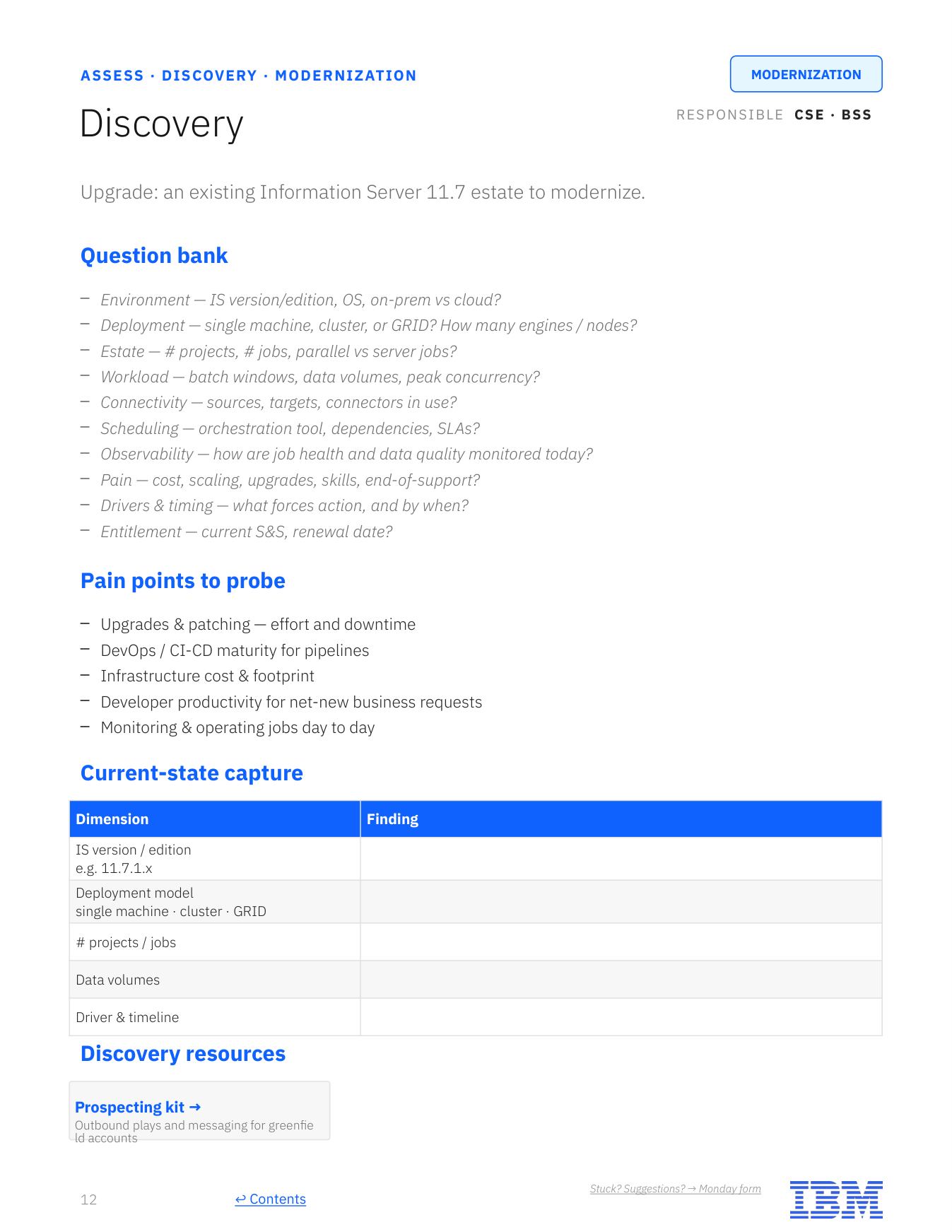
  • Discovery question banks
  • Qualification scorecards
  • PoC entry & exit criteria
  • Full glossary
Internal IBM asset. Reach out to talk through the full document.
Competitive Benchmark

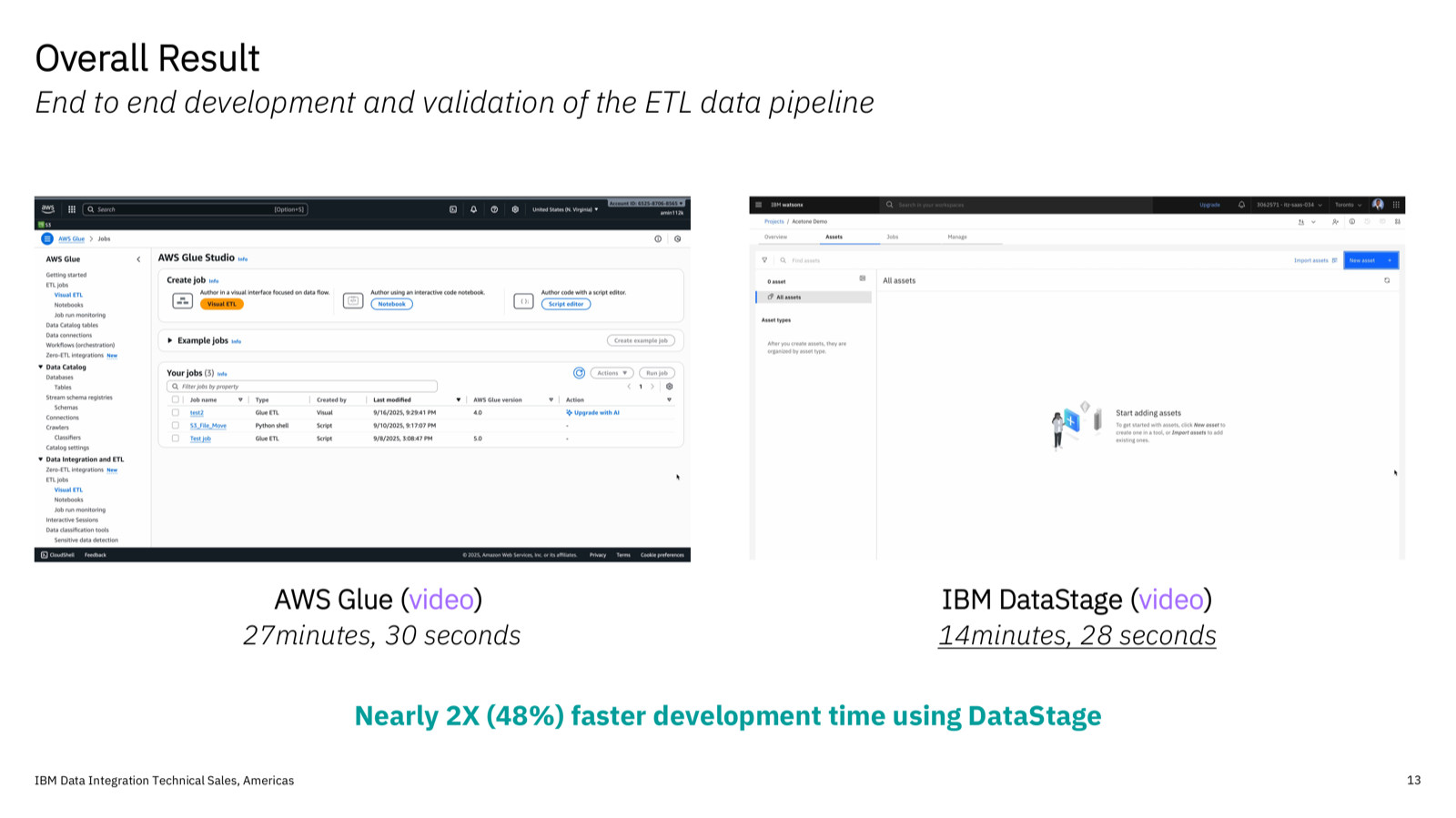
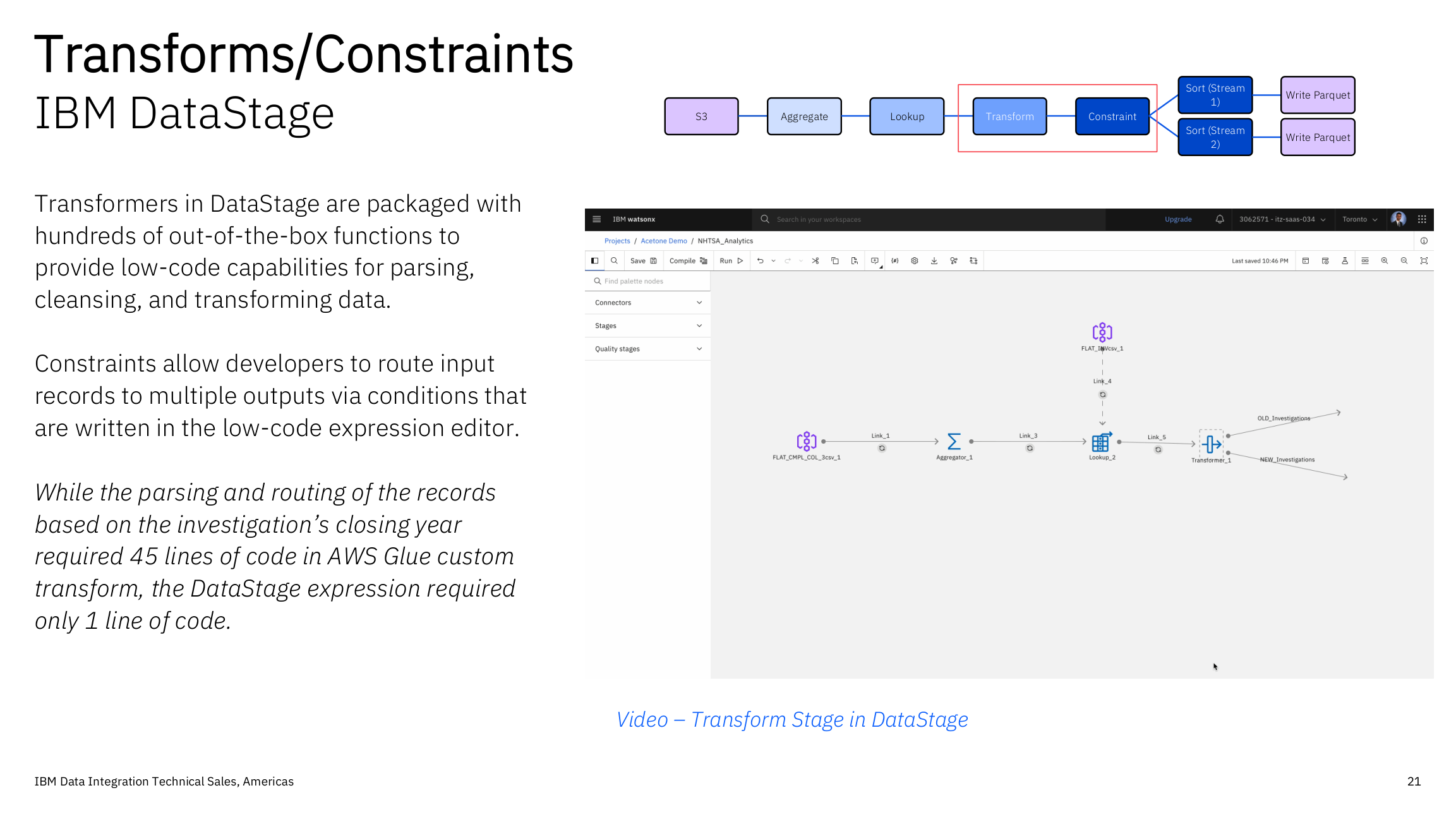
IBM DataStage vs. AWS Glue 4.0

The pain

Sales engineers needed a technical asset to combat AWS Glue. It already sits in every AWS customer's console and looks free, so "why pay for an ETL tool?" came up in deal after deal, and we had no hard numbers to answer with.

The outcome

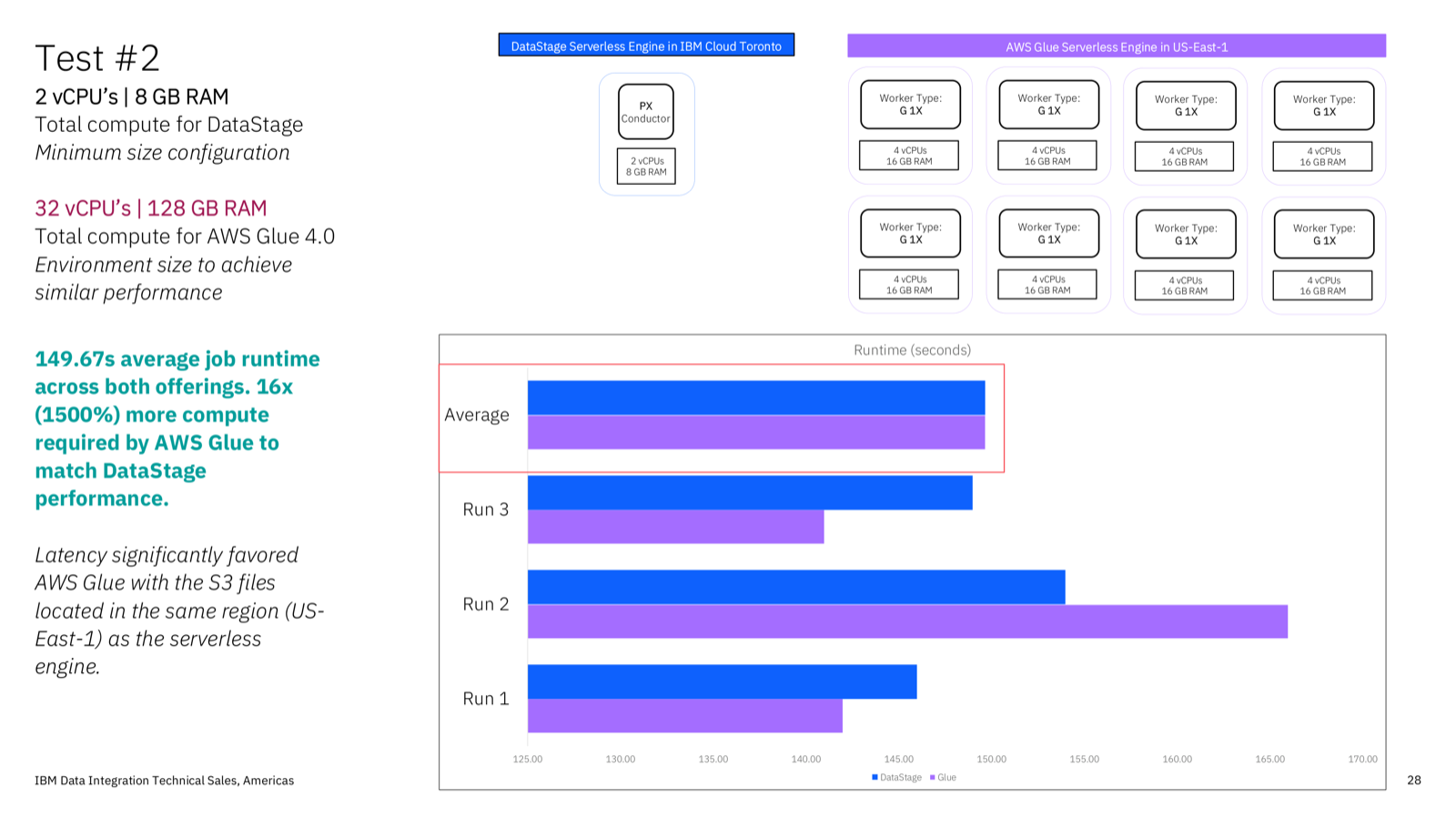
I built the same pipeline in both tools and timed everything: development, execution, and cost. I gave Glue the home-field advantage (same-region S3, its native file formats) and DataStage was still twice as fast to build in, and Glue needed 16× the compute to match it at runtime. Sellers now walk into evaluations with exact configurations and per-run numbers instead of talking points.

faster pipeline development in DataStage (14:28 vs 27:30 on the identical build)
16×
more compute required by Glue to match DataStage job execution performance
~$300K
3-year savings with DataStage across licensing and engineering effort

Execution parity test: at identical average runtime (149.67s), DataStage ran on 2 vCPU / 8 GB while Glue needed 32 vCPU / 128 GB.

Full methodology and per-run numbers available. Reach out for a walkthrough.
Demo Application · Trustworthy AI

Elevator Q&A: governed RAG in a container

The pain

Prospects kept asking whether watsonx.governance only governs and monitors IBM agents or LLMs. Most of our clients run external agents or Anthropic and OpenAI models somewhere, so an ambiguous marketecture slide did not settle the concern. Stakeholders needed a real proof point to move forward.

The outcome

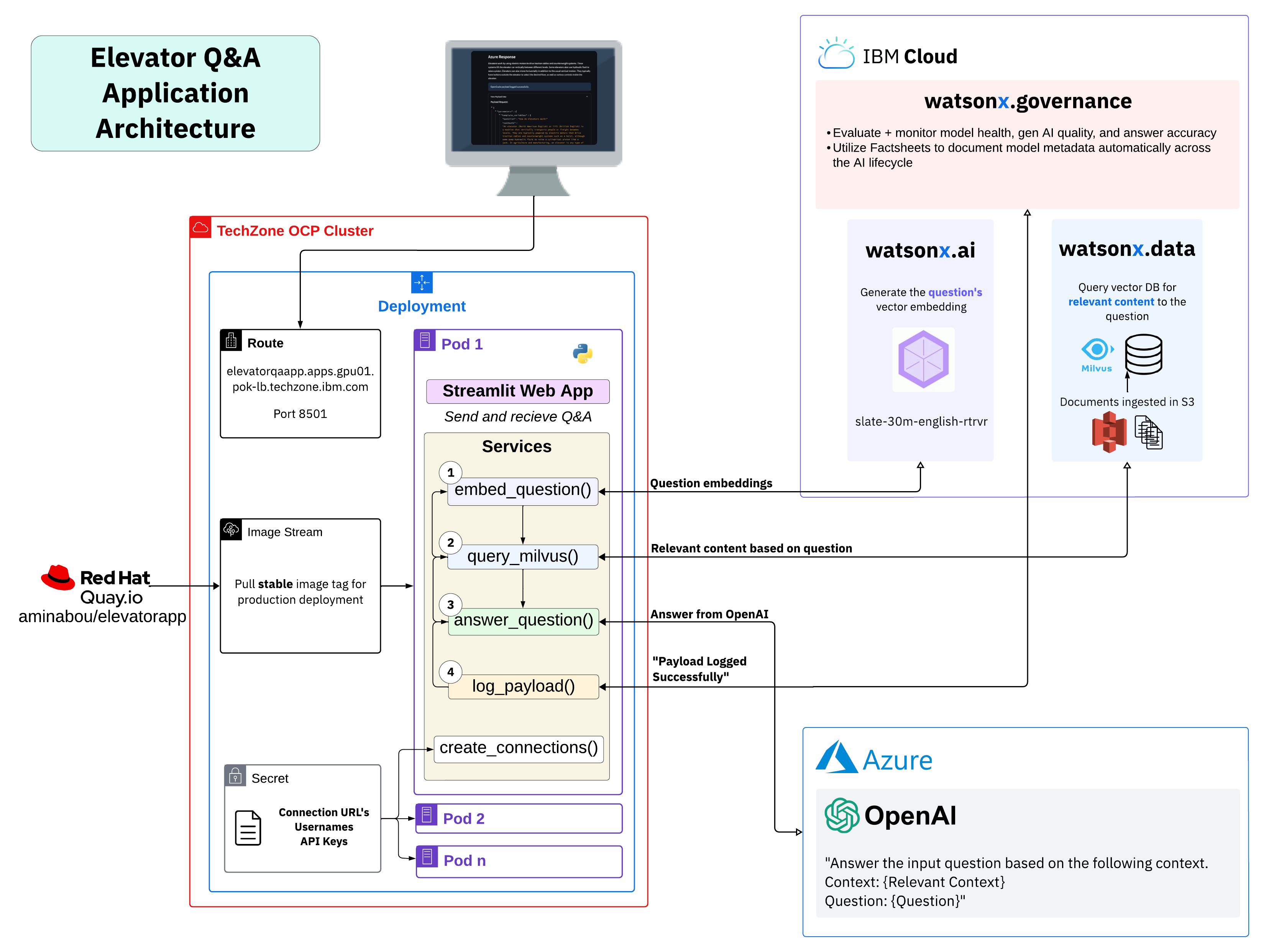
I built and recorded a containerized app that governs someone else's model. watsonx.ai embeds the question, Milvus returns the grounding context, Azure OpenAI writes the answer, and every request and response lands in watsonx.governance for monitoring. Ten minutes of working software settles what an hour of slides couldn't.

  • Streamlit
  • Milvus
  • watsonx.ai embeddings
  • Azure OpenAI
  • watsonx.governance
  • Containerized
Architecture diagram: user question flows through watsonx.ai embeddings and Milvus retrieval into Azure OpenAI, with payloads logged to watsonx.governance
Application architecture. Click to view full size.
Blog

Data is Everything

My blog on everything data: governance, integration, lakehouses, and the ideas shaping how enterprises get value from their data.

Latest: “Lakehousing vendors got your data, everything else is still your problem”